Heat pumps
Heat pump maintenance: what you can do and what a tune-up covers
A plain checklist for keeping a heat pump running through a wet Puget Sound winter, and what a technician should do on a service visit.

Short answer
Check your heat pump's filter every month and change or clean it at least every three months, keep the outdoor unit clear of debris, and have a technician service the system at least once a year. Twice a year, in spring and fall, is better for a heat pump because it both heats and cools.
The U.S. Department of Energy says the energy use of a well-maintained heat pump and a severely neglected one can differ by 10% to 25%.
Heat pump maintenance at a glance
| Task | Who | How often |
|---|---|---|
| Check the air filter (ducted systems) | You | Monthly; change at least every 3 months |
| Clean ductless (mini split) filters | You | Every 2 weeks in heavy use |
| Clear leaves, needles, and debris from the outdoor unit | You | Whenever debris builds up |
| Clean supply and return registers | You | As needed |
| Clear heavy snow off and around the outdoor unit | You | After a snowfall |
| Professional tune-up | Technician | At least yearly; spring and fall is better |
| Refrigerant charge, leak check, electrical, airflow, controls | Technician | Each tune-up |
| Defrost cycle, reversing valve, and backup heat test | Technician | Fall tune-up |
What you can do between visits
Filters
For a ducted heat pump, ENERGY STAR recommends checking the filter every month, changing it when it looks dirty, and changing it at least every three months. The Department of Energy gives the same three-month interval, or whatever your manufacturer or installer specifies.
Ductless heads need more attention. Mitsubishi's owner's manual for its MSZ-GL wall units says to clean the air filter every two weeks, by vacuuming or rinsing it. Fujitsu's Halcyon manual says every two weeks during normal use, and Daikin's manual recommends the same. Trane says every two weeks in peak season and about once a month the rest of the year. Let a rinsed filter dry completely before it goes back in.
The outdoor unit
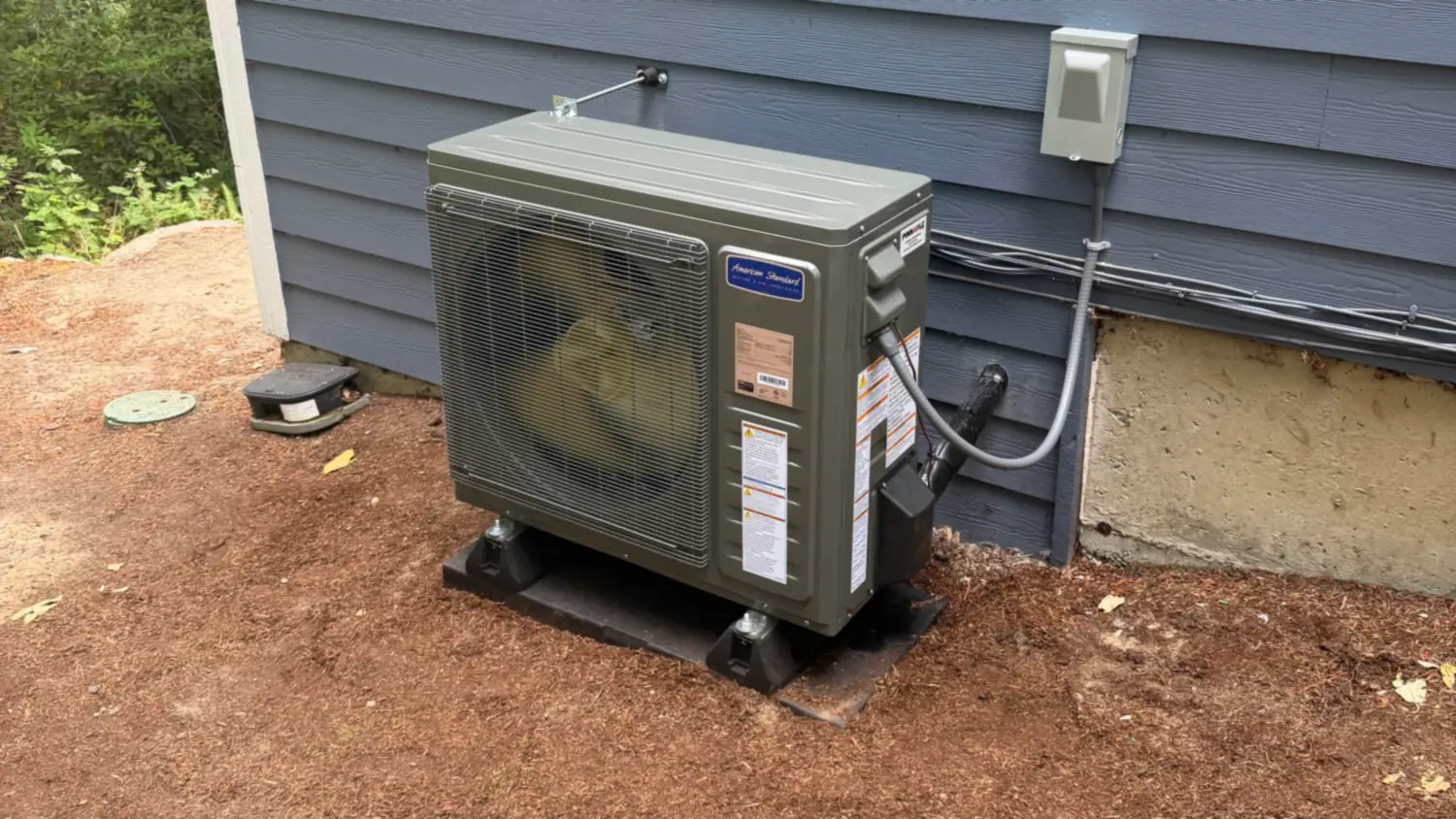
With the power to the unit off, clear away leaves, pollen, and debris, and clean the outdoor coil whenever it looks dirty, as DOE recommends. Around Puyallup that usually means fir needles, maple leaves, and whatever the yard grows toward the cabinet.
Keep plants and stored items back. Required clearances depend on the model, so check your installation manual. As one example, Trane's installer guide for its J4HP5 heat pump calls for at least 12 inches from walls and shrubs, 60 inches of open space above the unit, and a base raised 3 to 12 inches so water from the defrost cycle can drain before it refreezes. The same guide says to keep the drain holes in the base pan clear.
Do not wrap the unit in a solid cover for winter. Trane advises against it because the heat pump runs all season.
Inside the house
Clean the supply and return registers and keep furniture and rugs off the returns. DOE notes that a heat pump needs clear return air paths to run efficiently.
What to leave to a technician
Refrigerant work is not a homeowner job. The EPA allows only Section 608 certified technicians to buy refrigerant for home air conditioning and heat pump equipment, and it prohibits venting refrigerant during service. A system that is low on refrigerant has a leak that needs to be found.
What a professional tune-up covers
The Department of Energy lists what a technician should do on a heat pump service visit:
- Inspect the ducts, filters, blower, and indoor coil for dirt and obstructions
- Find and seal duct leaks
- Measure airflow
- Measure the refrigerant charge and check for leaks
- Inspect electrical terminals, clean and tighten connections, and apply a nonconductive coating if needed
- Lubricate motors and check belts for tightness and wear
- Confirm that heating is locked out when the thermostat calls for cooling, and the reverse
- Confirm the thermostat works correctly
Carrier adds items that matter going into winter: testing the defrost cycle and checking the reversing valve, the auxiliary heat, the capacitor, and the condensate drain. For ductless systems, Mitsubishi recommends periodic professional service of the indoor blower wheel and coil.
A good visit ends with a record of what was checked and what was found. Our maintenance plans include a multi-point inspection with a written report of any findings.
How often to book service
DOE says a heat pump should see a technician at least once a year. Carrier recommends twice a year, in spring for cooling and in fall for heating, and Trane says twice a year is better for ductless systems. ENERGY STAR's timing matches: check the cooling side in spring and the heating side in fall.
Twice a year fits this area because a heat pump here works most of the year. Sea-Tac averages 4,376 heating degree days a year under NOAA's 1991 to 2020 normals, so heating demand stretches from fall into spring, and the same unit handles cooling in summer.
Winter frost, defrost, and steam
Puget Sound winters sit near freezing and stay wet, and that combination frosts an outdoor coil. The numbers from Sea-Tac Airport:
37.7°FAverage January low
25.2Nights a year at or below 32°F
4,376Heating degree days a year
39.34 inAverage yearly precipitation
Source: NOAA National Centers for Environmental Information, U.S. climate normals 1991 to 2020, Seattle-Tacoma International Airport.
Nights at or below 32°F at Sea-Tac, by month
When frost builds up, the heat pump runs a defrost cycle. It briefly reverses to warm the outdoor coil, and your backup heat may come on to cover the gap. Trane notes that a cloud of steam from the outdoor unit during defrost is perfectly normal.
What is not normal: a unit that seems to be in defrost constantly, or ice that keeps building along with loud noise. Trane's advice for either is to call an HVAC professional, and we agree. After a snowfall, clear heavy snow off the top of the unit and away from its base, and never chip ice off the coil with a tool.
Filters during wildfire smoke season
For smoky days, the EPA recommends a high-efficiency HVAC filter rated MERV 13 or higher, fitted snugly so air does not slip around it. It also suggests setting the system fan to "On" instead of "Auto" so air keeps moving through the filter, and replacing the filter when it turns dark brown or black.
Not every system can take a MERV 13 filter. The EPA says a technician can tell you the highest-efficiency filter your system can handle, and DOE notes that thicker pleated filters usually need a modified filter cabinet. Ask about it at your next tune-up. For whole-home filtration, see indoor air quality.
Maintenance, registration, and your warranty
Heat pump warranties cover defects under normal use and maintenance, and the longer coverage usually depends on registering the equipment on time.
| Brand | Register within | What registration changes |
|---|---|---|
| Carrier (24VNA6 and 25VNA4 heat pumps) | 90 days | 10-year coverage instead of 5 |
| Trane | 60 days | 10-year parts coverage instead of 5 on standard terms |
| Daikin ductless | 60 days | Adds the extended coverage |
| Mitsubishi Electric | 90 days | 12-year parts and compressor coverage when installed in a single-family home by a Diamond Contractor or Ductless Pro |
Carrier's warranty requires care and maintenance that follow the owner's manual, and Trane says skipping a licensed HVAC professional for installation and maintenance can void the warranty. The warranties we reviewed exclude routine maintenance itself, such as filter cleaning, coil cleaning, and lubrication, so those stay with the owner. Keep your service records with the warranty paperwork.
What a tune-up costs
National cost guides give a wide range, and local pricing varies.
| Source | Service | Range |
|---|---|---|
| Angi (updated Jul 9, 2026) | HVAC maintenance visit, $250 average | $100 to $650 |
| Angi | Basic heat pump maintenance, per year | $80 to $150 |
| Angi | Mini split maintenance | $300 to $550 |
| HomeAdvisor (updated Jun 19, 2026) | HVAC service visit, $250 average | $175 to $350 |
| HomeGuide | Heat pump tune-up | $70 to $200 |
| Angi and HomeAdvisor | Maintenance plan, per year | $150 to $300 |
Puget Sound Energy and Tacoma Power do not offer rebates for heat pump tune-ups in 2026; their heat pump programs pay toward new installations. Call us for current pricing on a heat pump tune-up or a maintenance plan.
Frequently asked questions
How often should a heat pump be serviced?
At least once a year, according to the U.S. Department of Energy. Carrier recommends twice a year, in spring before cooling season and in fall before heating season, because a heat pump runs in both.
How often should I change my heat pump filter?
Check it monthly and change it at least every three months, per ENERGY STAR. Ductless mini split filters usually need cleaning every two weeks during heavy use, according to Mitsubishi, Fujitsu, and Daikin owner's manuals.
Is it normal for a heat pump to steam in winter?
Yes. During a defrost cycle the outdoor coil warms up to melt frost, and Trane notes that a cloud of steam from the outdoor unit is normal. Call a technician if the unit seems stuck in defrost or ice keeps building up.
Can I add refrigerant to my heat pump myself?
No. The EPA allows only Section 608 certified technicians to buy refrigerant for home heating and cooling equipment. A system that is low on refrigerant has a leak that needs to be found and repaired.
Should I cover my heat pump in winter?
No. Trane advises against a solid cover because the unit runs all winter. Keep snow off the top and away from the base so defrost water can drain.
Does PSE offer rebates for heat pump maintenance?
No. Puget Sound Energy's 2026 heating rebates pay toward new heat pump installations, not tune-ups, and Tacoma Power's heat pump program works the same way.
Book a heat pump tune-up
Dennis services ducted heat pumps and ductless systems across Puyallup, South Hill, Tacoma, and the rest of Pierce County. See our maintenance plans or read about heat pump service in Puyallup.
Sources 26 sources, click to expand
- U.S. Department of Energy, Operating and maintaining your heat pump.
- ENERGY STAR, Maintenance checklist.
- ENERGY STAR, Heating and cooling.
- Carrier, Heat pump service and maintenance.
- Trane, Do mini splits have filters? (modified July 25, 2025).
- Mitsubishi Electric, MSZ-GL owner's manual (JG79Y039H01).
- Mitsubishi Electric Trane HVAC US, HVAC maintenance tips (May 12, 2024).
- Fujitsu, Halcyon ASU9RL operating manual.
- Daikin, Cleaning the air filters.
- Trane, J4HP5 heat pump installer's guide (July 26, 2022).
- Trane, Extreme winter weather preparation for your home and HVAC (modified February 2, 2026).
- Trane, What is a heat pump defrost cycle? (February 19, 2026).
- U.S. EPA, Refrigerant sales restriction (updated March 23, 2026).
- U.S. EPA, Prohibition on venting refrigerants (updated December 8, 2025).
- NOAA National Centers for Environmental Information, U.S. climate normals 1991 to 2020, Seattle-Tacoma International Airport (USW00024233) (accessed September 15, 2026).
- U.S. EPA, Wildfires and indoor air quality (updated September 2, 2026).
- U.S. EPA, Strategies to reduce wildfire smoke exposure indoors (updated October 10, 2025).
- Carrier, Heat pump limited warranty, 24VNA6 and 25VNA4 (July 2023).
- Trane, Trane warranties explained (modified September 16, 2025).
- Daikin, Ductless limited warranty (December 2021).
- Mitsubishi Electric Trane HVAC US, Register your product.
- Angi, How much does HVAC maintenance cost? (updated July 9, 2026).
- HomeAdvisor, AC and HVAC service costs (updated June 19, 2026).
- HomeGuide, Heat pump maintenance and repair cost (page dated January 29, 2025).
- Puget Sound Energy, Heating rebates.
- Tacoma Public Utilities, Tacoma Power heat pump incentives (modified September 4, 2026).
Keep reading
-
Heating
How long does a furnace last?
Lifespan figures from ENERGY STAR, DOE, and manufacturers, western Washington factors, warning signs, and repair or replace tests.
-
Heating
Furnace replacement cost in Pierce County, WA (2026)
Ballpark ranges by home size, what moves the price, permit fees, Washington sales tax, and which rebates still apply in 2026.